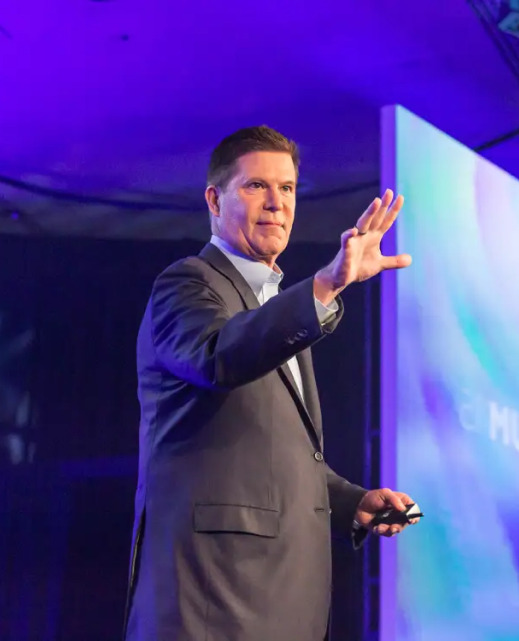

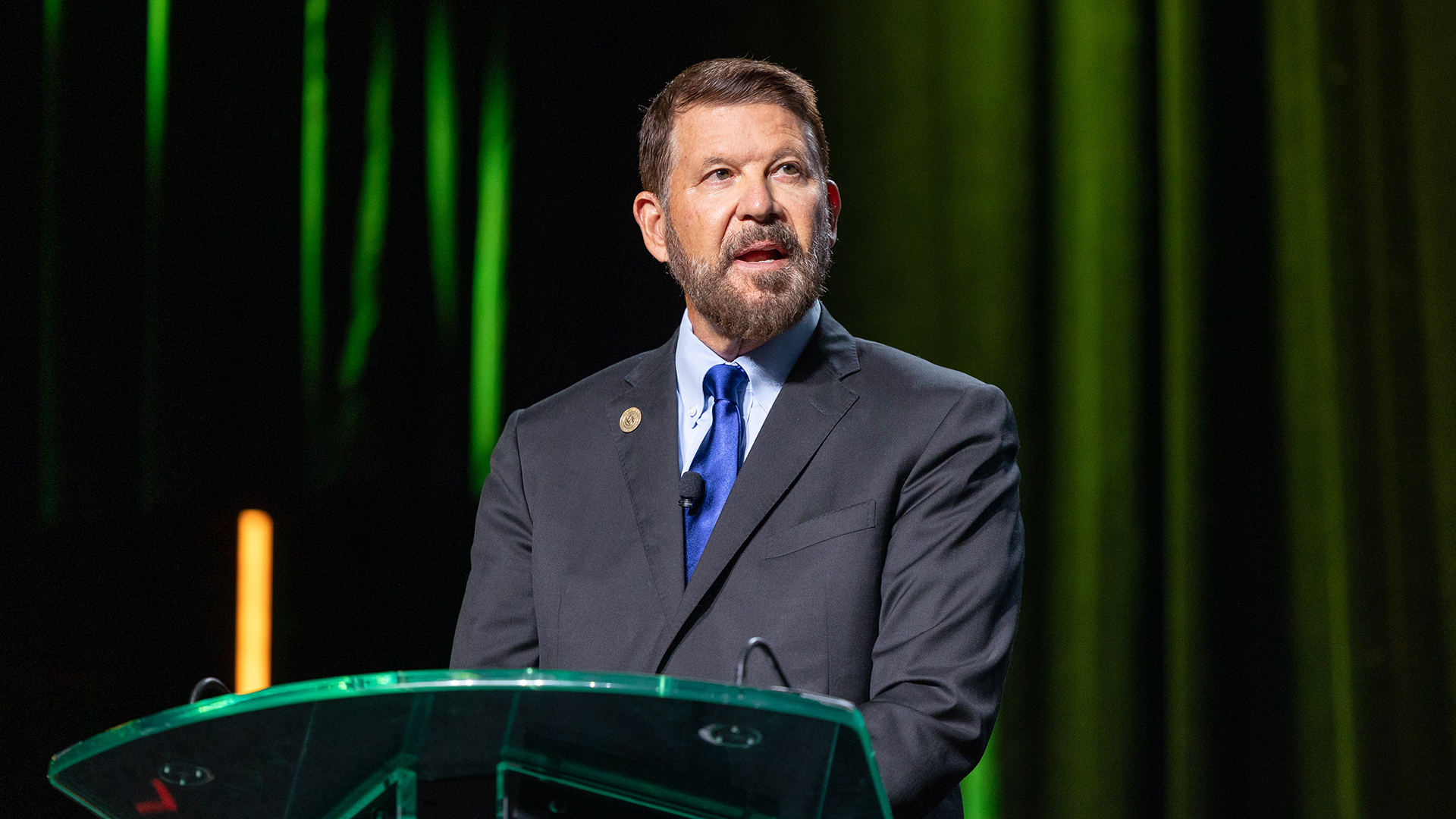
Closing Keynote by Keith Krach, Recipient of the 2025 Merchant Medal, the Nation’s Highest Honor for Manufacturing Leadership
Event: SEMICON West 2025 · September 6–9 · Phoenix Convention Center
“Sometimes I feel like my life’s been one long Forrest Gump story. I started as a welder in my dad’s five-person machine shop in Ohio — a kid with a blowtorch and a dream. He taught me that hard work, honesty, and a firm handshake could build anything — including trust. After a hot summer day in the factory, he’d slap me on the back and say, “We can’t solve world peace, but we can try!”
“His dream was that I’d get some college knowledge, become an engineer, and come back to grow the shop — maybe to ten employees. Well, the road took a few turns. I somehow became the youngest VP in GM’s history — and then did what everyone thought was crazy: I quit. I left my plush office in Detroit for a folding chair in a place called Silicon Valley. We built Rasna and invented MDS, sold it for half a billion. Built Ariba and invented B2B e-Commerce, took it to forty billion. Then turned DocuSign into a verb and proved that digital trust could move faster than paper.
“As we were approaching a billion users at DocuSign, I went on a scouting mission to China. I’d been going there since 1981, but this time felt different. Years earlier, the CCP — through Alibaba — had stolen a pile of Ariba’s IP. Now Xi was turning techno-competition into techno-aggression. Flying home, I kept thinking, the guys with the best technology always win the war. I wondered if the leaders in Washington knew about it.
“A week later, I went to find out. Next thing you know, I’m asked, “Have you ever thought about serving your country?” I said, “That’s a dream I never knew I had. I’d be honored.” Then they asked, “Can you move?” and just to sound macho I said, “Anywhere in the world.” This Ohio boy began his journey welding parts and later had the good fortune of welding together billion-dollar companies. But even this dreamer could have never imagined that one day he’d be asked to weld together America’s alliances — as Under Secretary of State, leading U.S. economic diplomacy and giving back to this great nation that had given so much to him and his family.
“They handed me three thick binders to prep for my Senate confirmation. One for every country. One for every industry. One for every major initiative. I said, “Not a problem — I went to Catholic grade school. I can commit them to memory.” A few weeks later, I was sitting in my Senate confirmation hearing saying, “Our rivals are playing the long game — a four-dimensional game of economic, military, diplomatic, and cultural chess. With little respect for human rights, intellectual property, the rule of law or sovereignty of nations. Superpower advantage can vanish in an instant — and there’s no substitute for American leadership.”
“Somehow, I was unanimously confirmed. A friend told me afterward, “It was because I had a strategic advantage.” I said, “I thought so — what is it?” He said, “Nobody knows you.” I said, “Perfect. I knew that would come in handy someday.” Thursday — confirmed. Friday — sworn in. Saturday — on a plane to Bahrain. Then to Osaka for the G-20. Then the President decides he wants to go to North Korea. Three continents, thirty-six hours, zero sleep. We refueled in Alaska. I grabbed a stale doughnut at a tiny visitor center… and left my classified phone behind. Not good.
“By Monday, I got the charge: Develop and operationalize a Global Economic Security Strategy — one that drives economic growth, strengthens national security, and counters authoritarian aggression. I thought, “Holy crap.” My CEO instincts kicked in — I needed a high-performance team. Everyone had warned me, “If you want a friend in Washington, get a dog.” I already had a dog. So instead, I called a dozen of my battle-scarred Silicon Valley veterans — people who’d been through the fires of innovation — and said, “It’s time to pay back our country.” They came.
“The first thing I did was meet one-on-one with about sixty foreign counterparts. I’d ask: “How’s your country’s relationship with China?” Every single one started the same way: “Well, they’re an important trading partner…” Then they’d lean in and whisper, “…but we don’t trust them.” That’s when the bells went off. For ten years at DocuSign, I’d said the same thing: “We’re not in the software business—we’re in the trust business.” We dealt with people’s most important documents—the ones they sign. I realized the same rule applies to nations. Countries trade, invest, and ally only with those they trust. That was my light-bulb moment — the birth of the Trust Doctrine.
“One of our most urgent missions was to stop authoritarian regimes from seizing control of global 5G. Their momentum looked unstoppable. If Beijing succeeded, 5G wouldn’t just carry data — it would give them reach into everything: power grids, ports, cars, even hospitals. Previous U.S. efforts had failed. Both parties were sounding the alarm. If we didn’t act fast, Huawei would win by default. We needed a bold opening move — what the press called the 5G Trifecta.
“Prong One — Cut Off Huawei’s Chips. We tightened export controls and used our edge in design and manufacturing tools to cut off Huawei’s access to advanced semiconductors — making it clear their supply chain was living on borrowed time.
“Prong Two — Secure Semiconductor supply chain. In 2020, not a single advanced chipmaker planned to manufacture in the United States — not one. We knew that because we’d spoken with every CEO. And we also knew this wasn’t just an economic issue — it was a national security emergency.
“So, our strategy was laser-focused: go for the biggest of them all — TSMC. The goal wasn’t just to land a factory; it was to ignite a chain reaction that would rebuild America’s trusted semiconductor supply chain. I called the chairman and said, “We need you to build in America. You’ll be close to your customers, your suppliers, and the world’s largest market. We’ll make it worth your while.” Two weeks later, our team and TSMC reached a $12 billion agreement — the largest onshoring in U.S. history.
“That trust triggered a chain reaction that changed everything. Suppliers followed. Competitors reinvested. And universities — like Purdue — stepped up to close the talent gap by launching America’s first master’s program in semiconductor engineering. Everyone got the best part of the deal. TSMC gained proximity to customers like Apple, NVIDIA, and AMD. America gained thousands of high-paying jobs, a revitalized manufacturing base, and a stronger domestic chip ecosystem. And the free world gained a secure, trusted semiconductor supply chain — the lifeblood of freedom itself.
“Then President Trump took that momentum and scaled it into something historic —a $165 billion commitment, six fabs, two advanced packaging facilities, and a major R&D center. It became the largest foreign direct investment in U.S. history and the spark that ignited a semiconductor renaissance. Today, with 130 new projects across 28 states and over 500,000 jobs in motion, the United States once again leads the world in the technology that underpins freedom itself.
“Prong Three — The Clean Network. A coalition of trusted partners committed to keeping authoritarian vendors out of their 5G systems. It was the Trust Doctrine’s first real-world test. Every member — nation, telecom, or company — had to operate by a clear set of trust principles: integrity, transparency, reciprocity, and respect for human rights, rule of law, property, national sovereignty.
“Those values together form the foundation of trust. They are the principles we honor in the free world — and the ones authoritarian regimes do not. They actually use it against us for their own strategic advantage. So, in a one jiu-jitsu move, we turned the tables on them — weaponizing the very principles that protect freedom.
“In less than a year, The Clean Network had 60 Clean Countries, representing two-thirds of global GDP; 200 Clean Telcos, and dozens of industry-leading Clean Companies joining the cause. It became the largest alliance of democracies in modern history — the first time nations ever coordinated global technology policy at scale, without firing a single shot. In the process, we created a new transformational model based on trust that integrates Silicon Valley strategies with traditional foreign policy tools which is now known as tech diplomacy
“As General H.R. McMaster put it: “The Clean Network’s defeat of the CCP’s 5G masterplan was the first time a U.S.-led initiative proved that China’s economic warfare is beatable — because it exposed their biggest weakness: nobody trusts them.”
“Frankly, the only thing that scares the shit out Xi more than a united United States is a united alliance of democracies. And yes — as a result, the CCP declared me an enemy of the state and sanctioned my family. Not for what I said, but for what our team achieved. But this small-town kid from Ohio, blessed by the American dream, will never bend the knee to Emperor Xi. Because this wasn’t just a victory for 5G — it was a blueprint for how to win the future. That insight became the foundation of the Trust Doctrine.
“After my term ended, we continued the mission by launching the Krach Institute for Tech Diplomacy at Purdue. which is fast becoming the world’s preeminent institution for advancing freedom through trusted technology. Our mission is simple: accelerate the development and adoption of trusted technology into every critical and emerging field — from 5G to semiconductors to AI. To turn principle into practice, we took the concept behind the clean network and expanded it into the Global Trusted Tech Standard — or xGTT
“xGTT is a practical benchmark that measures the trustworthiness of technologies–how they are designed, deployed, and governed. It reduces friction, accelerates innovation, and enables seamless collaboration among trusted partners. That’s why this year’s SEMICON theme — “Stronger Together: Shaping a Sustainable Future in Talent, Technology, and Trade” — couldn’t be more fitting.
“Talent gives us the hands. Technology gives us the tools. Trade gives us the reach. But trust gives us the strength to hold it all together. Without trust, talent leaves. Without trust, technology divides. Without trust, trade collapses. Because trust isn’t just a moral value — it’s the ultimate competitive advantage. And for the first time, the free world now has its own playbook — one that proves trust is stronger than fear.
“Before I close, I want to leave you with the words of one of America’s great transformational leaders — and one of my mentors — Secretary George Shultz. Just a month before he passed, at the age of 100 He wrote: “December 13th marks my turning 100 years young. I’ve learned much over that time, but looking back, I’m struck that there is one lesson I learned early and then relearned over and over: Trust is the coin of the realm. When trust was in the room, whatever room that was—the family room, the schoolroom, the locker room, the office room, the government room, or the military room—good things happened. When trust was not in the room, good things did not happen. Everything else is details.”
“I can feel that trust in this room. You — the engineers, the builders, the innovators — have more influence over the future of freedom than any generation in history. When you go back to your teams, your labs, and your fabs, remember this: “It’s not just about innovation. It’s about freedom.” Because every chip you design and every system you create carries something far greater than code — it carries the power to defend free thought, to expand opportunity, and to keep the human spirit free.
“Integrity isn’t inherited — it’s earned, one choice at a time. And the same values that built this nation — hard work, honesty, respect, and fair play — are the values that will build the next era of trusted technology. Freedom isn’t guaranteed. It’s a decision we renew — every generation, every day, every moment we choose trust over fear. Freedom, like a chip, must be engineered, protected, and renewed —because every innovation built on trust is, in the end, a victory for freedom itself. We’ve done it before. We’ll do it again. And just like that kid from Ohio with a blowtorch and a dream, we’ll keep building — not just technology, but the architecture of trust.
“So, thank you — for what you build. Thank you — for what you believe. And thank you — for what you do every day to keep the human spirit free. God bless you, and God bless the United States of America.”