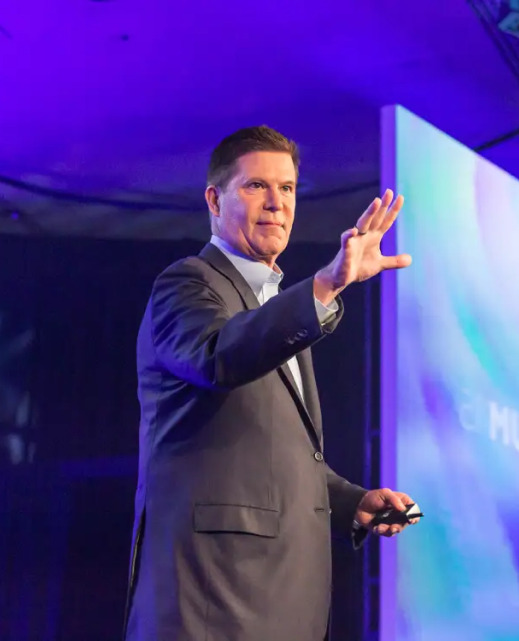

Freedom 250 CEO Keith Krach announces our nation’s celebration of 250 years of independence at the World Economic Forum in Davos
Freedom 250 champions freedom for all. As Keith said, “When freedom exists, innovation follows. Where innovation flourishes, prosperity grows. And where prosperity is shared, stability becomes possible.”
Full transcript of the conversation:
Under Secretary of State Sarah Rogers:
Joining us — I would add, so early for those of you who are coming from the U.S. Eastern Time Zone, as I am — welcome to America House.
So I am here with Keith Krach, CEO, Freedom 250. And I’m going to introduce him for a bit, and he’ll give short remarks, and then we’ll have a Q&A on our plans for America’s 250th birthday.
So in America, we have this great tradition of great builders who grow up in the country’s heartland and build things with their hands before building companies and legacies. And that is Keith. We’ve got one of them right here.
So Keith grew up in his father’s small Ohio machine shop, welding at the age of 12, before rising to become the youngest vice president in the history of General Motors — a great American company and a pioneer in the industrial robotics industry.
Keith later founded Ariba, creating the world’s largest business-to-business e-commerce network, and went on to build DocuSign into the global standard for digital trust, transforming the company name into a verb. And during COVID, we all remember how reliant we were on DocuSign. You can thank Keith.
Last year, he was awarded the 2025 Merchant Medal, the nation’s highest manufacturing honor, recognizing contributions that helped drive more than $4.5 trillion in global productivity.
Here in Davos, he was also named a World Economic Forum Technology Pioneer in 2000. In public service, Keith led American economic diplomacy as United States Under Secretary of State for Economic Affairs — so my counterpart for economics. And he built the Clean Network Alliance, a coalition of democracies committed to trusted technology, more important than ever today.
Today, he continues that mission as Chairman of the Institute for Tech Diplomacy and as CEO of Freedom 250, leading the nation’s effort to deliver President Trump’s vision for our 250th birthday, focused on renewal and the future.
Please welcome Keith.
Keith Krach:
Thanks so much for that kind introduction. That was nice. And thank you all for being here.
You know, the United States is approaching a milestone, and it comes once in a lifetime: the 250th anniversary of our independence. For Americans, this is a moment to reflect. I think for the world, it’s a moment to take notice, because when the United States marks this moment, it says something important about how it understands its role in the world and its enduring commitment to freedom.
So this is not just simply a celebration. It’s an opportunity to renew confidence in freedom as a force for shared progress. You know, Ben Franklin famously said democracy is a remarkable thing — if you can keep it. And that reminder still matters.
Democracy doesn’t sustain itself automatically. It requires participation, trust, and shared responsibility. From my time in public service and also in Silicon Valley, I learned something very practical: freedom matters.
When freedom exists, innovation follows. Where innovation flourishes, prosperity grows. And where prosperity is shared, stability becomes possible. I also learned, particularly serving in government, that American leadership matters far beyond its borders.
And many nations represented here in Davos know that freedom, opportunity, and security are built through cooperation, alliances, and shared values. And that’s not by accident.
Today those values are being tested. There are forces in the world that would prefer to weaken our freedoms and to take away our futures. And that’s exactly what Freedom 250 is about — why it matters not just for the U.S., but for the world.
At its core, Freedom 250 is what we call the triumph of the American spirit. That’s not a slogan. It’s an idea — the belief that people, given opportunity, can solve hard problems, build shared prosperity, and renew their societies together.
And I think it’s also important to understand here at Davos that spirit is not uniquely American. It underpins strong democracies everywhere.
Freedom 250 was created with that reality in mind. This is not a government campaign, and it’s not a single event. It’s a public-private movement.
The Freedom 250 network that we’re building is designed to mobilize participants in the United States, touching literally every American citizen, while engaging our allies, partners, and institutions around the world.
And Freedom 250 creates practical ways to engage through culture, education, technology, entrepreneurship, and civic exchange — not just as spectators, but as participants.
So for the international leaders here at Davos and in this room, the question is not how you observe our nation’s 250th anniversary. The question is: how will you shape a moment that will influence American leadership for the next generation?
And after being at Davos probably 20 times, I think there’s no better place to begin than right here, where ideas become partnerships and partnerships become action.
So I look forward to the conversation. Thanks.
Sarah Rogers:
Thank you. So I took office just recently, and I’ve begun traveling around the world in my State Department capacity for the first time. And one thing I’ve noticed is that no matter what else is going on — no matter what else we’re engaging on in these bilateral sessions — whenever the discussion turns to Freedom 250, people brighten.
And it’s something that we and our international partners all look forward to celebrating together. What do you think it is about Freedom 250 that resonates so much for the world beyond just America?
Keith Krach:
Well, I think it’s a celebration of freedom probably more than anything else. And that’s something I think the world holds dear.
You know, if you’re in a place — maybe it’s an authoritarian regime — if you whisper the word “freedom,” everybody’s going to come running.
And without freedom, there can be no prosperity. So this is a chance — really a unifying opportunity — that can be used as a catalyst for our allies and for our partners to role-model that and speak very proudly.
It’s about bringing pride back with regard to freedom, and in particular the values that define a democracy — things like respect for the rule of law, respect for intellectual property, respect for human rights, respect for the sovereignty of nations.
Those are the values of democracy.
Sarah Rogers:
Very, very well spoken. And I think it’s true. We see the brave people of Iran risking everything for freedom, and we see free people choose the same things over and over again.
Free people choose democracy. Free people choose certain kinds of entertainment products. And they choose that spirit that animates the United States when they’re able to do so.
So my next question is — I’m new to government and you’ve left government, and now you’re running this public-private partnership, which is really effectively bridging the strengths of the public and the private sector.
What did you learn during your time at the State Department about global leadership?
Keith Krach:
One of the things I said in my Senate confirmation hearing — they asked me what my overall strategy would be — and I said it was really to accentuate three of America’s strengths.
The first is strengthening partnerships with allies and friends. The second is leveraging the innovation and resources of the private sector. I think that’s a big untapped one. And the third is really amplifying American values, which are democratic values — the things we talked about.
And the interesting thing that I could really see is that freedom and democracy are an unnatural act. The law of physics is the bad king, the dictator, the emperor. And you have to fight every day for it.
It was great to see when I was in public service what great civil servants — career Foreign Service officers and political appointees — do, because you’ve got to fight every day.
And I think if it wasn’t for the U.S., there would probably be about 100 countries that would never have tasted an ounce of freedom.
I’ve got five children and five grandchildren, with another one on the way. And so it’s really doing it for them.
Sarah Rogers:
Well, we’re all grateful. You use the phrase “the triumph of the American spirit.”
I wonder how you think that applies to people outside the United States, and how you think about the American spirit in the context of Freedom 250, which is really a global celebration.
Keith Krach:
Yeah. I think it’s all about — I grew up in the Midwest — those values of hard work, honesty, reciprocity, integrity, fairness.
The triumph of the American spirit — the Founding Fathers of the U.S., they put their lives on the line, just like you see people doing around the world today, particularly in Iran.
So the triumph of the American spirit is good over evil.
And if you think about it, our rivals are playing the long game. By that I mean authoritarian regimes. It’s a four-dimensional game of chess — economic, military, cultural, diplomatic.
And at its core, the crossroads is technology. They have very little respect for human rights, sovereignty of nations, intellectual property — all those things.
And they use that against democracies to their advantage. The key is that’s something we should take advantage of.
One of the initiatives I led as Under Secretary of State was the Clean Network Alliance of Democracies. It was based on the trust doctrine — those values — and the idea that in order to do business in the technology world, you’ve got to subscribe to them.
So in one jujitsu move, we turned the table and weaponized the very principles that protect our freedoms.
Sarah Rogers:
In my lifetime, I feel like I’ve seen several surges of American innovation.
We had the manufacturing surge after World War II. Then in the 2000s, we had the first dot-com boom. Now we have robotics and advanced telecommunications infrastructure.
You’ve played a role in all of those, which makes you such a valuable partner in a discussion about the public-private intersection between American manufacturing, allied nations, and the quest for freedom.
Do you see through-lines across those economic chapters that teach us something about how economic development, freedom, and prosperity converge today?
Keith Krach:
Yeah. My career has been in robotics — back when that was considered high-tech in the early ’80s — then computer-aided engineering software, then Ariba, where we invented business-to-business electronic commerce, which now does $7.3 trillion in transactions per year — more than Amazon and eBay combined.
Then DocuSign — 1.5 billion users.
All of those technologies were about driving productivity. Productivity is the number-one driver of GDP, and the surrogate for that is increasing the standard of living.
Each one represented a paradigm shift — from controllers, to client-server architecture, to the internet, to cloud computing, to mobile acceleration.
Now AI is such a big opportunity.
Productivity drives prosperity.
And you’re seeing places like Iran struggle economically while craving freedom. That’s Freedom 250.
Sarah Rogers:
So Keith, as I mentioned, is the CEO of Freedom 250, and he’s got some thrilling events planned — a Great American State Fair, UFC 250, national prayer events, and many more.
This is a public-private effort. One of America’s great strengths is our private sector, along with our relationships with allies and organizations around the world.
If there are groups or people here at Davos who want to get involved and celebrate our birthday with us, what should they do?
Keith Krach:
Your imagination is your only limitation.
We would love to work with you. We’ve got toolkits for countries, states, companies — it’s all about partnership.
What could be funnier than marketing America — or really, marketing freedom?
There will be many big events in the U.S., and many overseas as well. Cultural exchange, education, history, innovation — innovation is one of our main pillars.
We’re here to catalyze that. Feel free to contact us.
Sarah Rogers:
Excellent. If someone had asked the Founders in 1776 what success looked like, I think it’s safe to say their proposition performed pretty well.
Looking ten years out, what does success look like for Freedom 250?
Keith Krach:
Renewal within the United States. Renewed pride in founding values and a deeper understanding of why they matter.
Freedom 250 is not just a celebration — it’s about the next 250 years.
Outside the U.S., it’s renewed emphasis on democratic values, freedom, unity, and reciprocity.
That’s success.
Sarah Rogers:
Let’s hope our birthday celebration can ignite and inaugurate some of that.
Thank you so much for joining us today. We look forward to the week and to celebrating 250 years of American excellence with all of you.
Keith Krach:
Thank you. Thanks so much.